
A data warehouse is a central database that stores cleaned, structured data from all of a company’s systems so it can be reported on and analyzed. Hoist DigiSoft’s data warehouse consultants design, build and migrate cloud data warehouses that become your single source of truth for BI and AI.
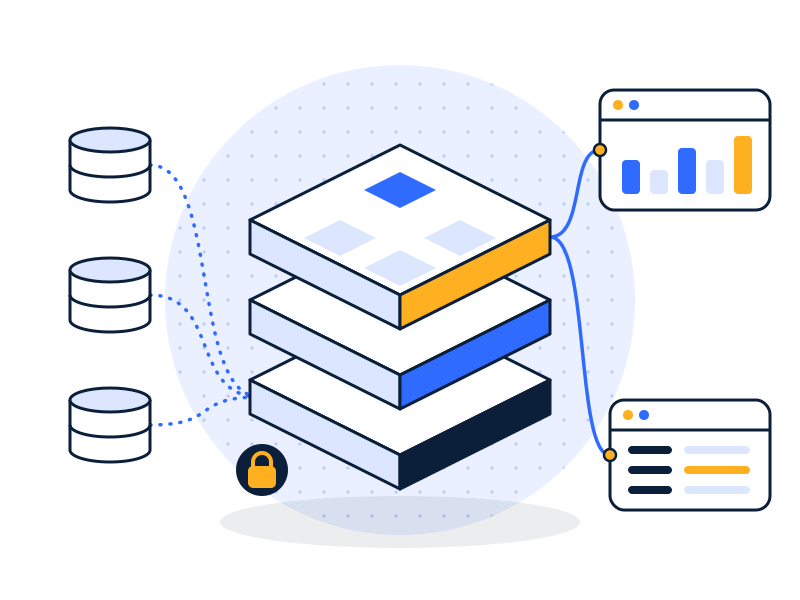
What is a data warehouse, and when do you need one?
A data warehouse is a database designed for analysis rather than day-to-day transactions. Your CRM is built to save one deal at a time. A warehouse is built to answer “what were sales by region, product and month for the last three years?” in seconds.
It does three things your source systems can’t:
- Combines sources. CRM, ERP, finance, ecommerce, support and spreadsheet data side by side, with matching customer and product IDs.
- Keeps history. Source systems often overwrite old values. A warehouse keeps them, so you can compare this year with last year accurately.
- Holds the rules once. “Net revenue” is calculated in one place, and every dashboard reads the same result.
You probably need one when:
- reports pull from three or more systems;
- dashboards are slow because they query live production systems;
- you need trends over years, not weeks;
- different teams build different versions of the same metric;
- you want predictive models or AI tools to work on reliable data.
You may not need one yet when you report from one or two clean systems, your volumes are small, and your BI tool’s built-in model handles it. We’ll say so in the audit.
What do our data warehousing services include?
Architecture and design
We choose the platform and design the layers: raw (data as it arrives), cleaned (standardized and deduplicated) and modeled (ready for reporting). You get an architecture document your own team can follow.
Cloud data warehouse build
We build the warehouse in your own cloud account wherever possible, so data stays in your environment. Infrastructure is defined as code where the platform supports it, so it can be rebuilt and reviewed.
Migration
We move on-premises databases (often SQL Server or older appliances) and spreadsheet “databases” to the cloud, with parallel running and reconciliation before cutover. See cloud data migration.
Data modeling
Star schema models with fact and dimension tables, built and tested with tools like dbt. Models are version-controlled and documented.
ELT pipelines
We load data from your sources with tools such as Fivetran, Azure Data Factory or AWS Glue, then transform it inside the warehouse. See data integration services for the pipeline side.
Performance and cost tuning
Cloud warehouses bill on compute and storage. We set up clustering or partitioning, right-size compute, schedule workloads and add cost alerts so the monthly bill doesn’t surprise you.
Managed support
Optional ongoing monitoring, pipeline fixes, new sources and model changes.
Which cloud data warehouse platform should you use?
We work with all the major platforms and recommend based on your existing cloud, skills and workloads, not on a partnership.
| Platform | Usually a good fit when | Points to weigh |
|---|---|---|
| Snowflake | You want a cloud-neutral warehouse with simple scaling and data sharing | Compute is billed by usage; needs cost guardrails |
| Google BigQuery | You’re on Google Cloud, use Google Analytics or Looker, or want serverless | Query-based pricing rewards good partitioning |
| AWS Redshift | You’re on AWS and want the warehouse close to S3 and other AWS services | Sizing and maintenance need more attention than serverless options |
| Azure Synapse / Microsoft Fabric | You’re a Microsoft shop and Power BI is your BI tool | Microsoft’s roadmap is moving to Fabric; plan accordingly |
| SQL Server | Data volumes are moderate, you have SQL Server skills, or data must stay on-premises | Scaling and high availability are your job |
AWS data warehousing services: on AWS we typically pair Redshift with AWS Glue or Fivetran for ingestion, S3 for raw storage and IAM roles for access. On Azure, Data Factory with Synapse or Fabric. On Google Cloud, BigQuery with Fivetran or native transfers.
Data warehouse vs data lake vs lakehouse: what’s the difference?
| Data warehouse | Data lake | Lakehouse | |
|---|---|---|---|
| Stores | Structured, cleaned tables | Any file: raw, semi-structured, unstructured | Files in open table formats with warehouse-like tables on top |
| Best for | BI, reporting, finance | Data science, large raw archives, logs | Mixed BI and data science on one platform |
| Typical users | Analysts, business users | Data engineers, data scientists | Both |
| Main risk | Rigid if designed badly | Turns into a “data swamp” without governance | More moving parts to manage |
For most mid-sized companies whose main goal is trusted reporting, a warehouse is the right first step. See the glossary for data lake and lakehouse.
How does a warehouse cut reporting cost and time?
- No more manual merging. Data from every source lands in one place on a schedule, so nobody exports and pastes.
- Faster dashboards. BI tools query a warehouse built for analysis instead of slowing down your production systems.
- Fewer disputes. Metrics are defined once and reused, so meetings move on from “which number is right?”.
- Lower error cost. Gartner estimates poor data quality costs organizations an average of $12.9 million a year. A warehouse with tested models catches bad data before it reaches a report.
- Ready for AI. Predictive models and AI assistants are only as good as the data they read. A modeled warehouse gives them clean inputs. See data mining and predictive analytics.
How does the process work, and how long does it take?

- Audit
- Architect
- Build & Secure
- Run & Improve
- Audit (1 to 2 weeks). Sources, volumes, reports, access and current costs.
- Architect (1 to 2 weeks). Platform recommendation, architecture, security model and first-phase scope.
- Build & Secure (4 to 8 weeks). Two to four priority sources, core models and the first dashboards pointed at the warehouse, with encryption, private networking and role-based access in place before real data lands. We reconcile warehouse numbers against source systems and finance figures before go-live.
- Run & Improve. Monitoring, cost reviews and changes, then more sources and models in further phases.
A first-phase warehouse typically goes live in six to twelve weeks. Migrations depend on the size and condition of the legacy system.
Security is built in from day one: encryption at rest and in transit, private networking where the platform supports it, role-based access, and key management options. See data security and encryption.
What does a warehouse project look like?
Illustrative example. Not a client project.
An ecommerce brand runs Shopify, a 3PL’s inventory portal, QuickBooks and three ad platforms. Margin reporting takes a week each month.
- Design: BigQuery in the brand’s own Google Cloud project; Fivetran for Shopify and ad platforms; a scheduled file load for the 3PL.
- Model: orders, refunds, ad spend and landed cost in one star schema; SKU-level contribution margin defined once.
- Result to aim for: a daily margin dashboard, with the month-end pack produced from the same model.
Industries: retail & ecommerce · manufacturing & logistics · healthcare · real estate
Common use cases: single source of truth · legacy-to-cloud migration · automated reporting
FAQs
What does a data warehouse consultant do?
A data warehouse consultant designs and builds the central database a company reports from. The work covers choosing a platform, designing the architecture and data models, building pipelines from source systems, tuning performance and cost, and setting up security. Good consultants also document everything so your team can run the warehouse without them.
Snowflake, BigQuery or Redshift: which is best?
Snowflake, BigQuery and Redshift are all mature cloud data warehouses, and none is best for everyone. BigQuery suits Google Cloud users, Redshift suits AWS users, and Snowflake suits teams wanting cloud neutrality. Microsoft shops often choose Fabric or Synapse. Your existing cloud, skills and workload patterns should decide it.
How long does a data warehouse project take?
A first-phase data warehouse, with two to four sources and core reporting models, typically takes six to twelve weeks from audit to go-live. Migrating a large legacy warehouse takes longer and runs in phases. Source data quality and how quickly business definitions are agreed matter more than platform choice.
Can we keep our on-premises database?
Yes. Many companies keep an on-premises database such as SQL Server for operations and copy data to a cloud warehouse for reporting. Others keep reporting on-premises for regulatory reasons. We design hybrid setups with secure gateways or private connections, and only recommend moving what genuinely benefits from the cloud.
How do you secure a data warehouse?
A data warehouse is secured with encryption at rest and in transit, private network access, role-based access control, masking of sensitive columns and audit logging. We build inside your own cloud account, use your SSO for sign-in, and give each pipeline and user the minimum access it needs.
One warehouse. Every report reads from it.
Book a free 30-minute data audit and we’ll tell you whether you need a warehouse yet, and which platform fits.