Data security services protect business data wherever it is stored or moved. Hoist DigiSoft secures the data layer: encryption at rest and in transit (AES-256, TLS 1.2+), key management, role-based access, secure integration protocols, and audit logging, so your warehouse, pipelines and apps are built to the security standards your customers and regulators expect.
What are data security services?
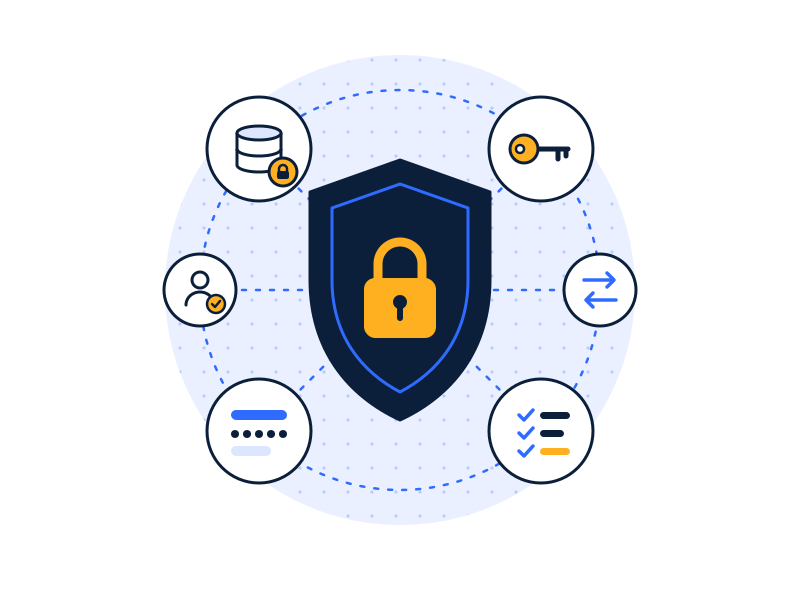
Data security services are the controls that keep business data confidential, accurate and available: who can see it, how it’s protected when stored and when moving, and how you prove it afterward.
We focus on the data layer: your databases, warehouse, pipelines, integrations and BI tools. That’s where consolidated data is most valuable, and where it’s most exposed, because one warehouse can hold what used to be spread across ten systems.
What we’re not: a managed security operations center, a 24/7 monitoring service or an auditor. We secure the data systems we build and the ones you already run, and work alongside your IT, security provider and auditors.
Why does it matter now?
IBM’s Cost of a Data Breach Report 2026 puts the global average cost of a breach at a record $4.99 million, and the US average at $11.5 million. In the same research, more than half (53%) of breached organizations said the sensitive data involved was not encrypted.
Encryption doesn’t stop every attack. It does mean that stolen files are far less useful to whoever took them, which is why we treat it as the default, not an upgrade.
What do our data encryption services cover?
Encryption at rest
Data stored in databases, warehouses, file storage and backups is encrypted, typically with AES-256. Every major cloud platform supports this; the work is making sure it’s switched on everywhere, including staging areas, exports and backups that people forget.
Encryption in transit
Every connection, from source system to pipeline to warehouse to dashboard, uses TLS 1.2 or higher. No plain-text database connections, no CSV files on unencrypted shares, no data in email attachments.
Field-level encryption, masking and tokenization
For especially sensitive fields (tax IDs, bank details, dates of birth), we encrypt or tokenize the field itself, or mask it so most users see only part of it. Analysts can still count and join records without seeing the raw value. See encryption at rest and encryption in transit.
Encryption, decryption and key rotation
Keys are created, stored and rotated in your cloud’s key management service (Azure Key Vault, AWS KMS or Google Cloud KMS), with customer-managed keys where you want control. Decryption is limited to the services and roles that need it, and every use of a key is logged.
Which security protocols do we implement?
- TLS 1.2+ on every connection.
- SSO through SAML or OpenID Connect, so access to data tools follows your identity provider (Microsoft Entra ID, Okta, Google Workspace).
- MFA enforced for every human account with data access.
- Least privilege and RBAC. Role-based access control: users and service accounts get only the data they need, defined by role, reviewed on a schedule.
- Row- and column-level security in the warehouse and BI tools, so a regional manager sees their region and nobody sees fields they don’t need.
- Network isolation. Private endpoints and IP restrictions so the warehouse isn’t reachable from the open internet.
- Secrets management. Passwords and API keys live in the key vault, never in code or spreadsheets.
- Audit logging. Who accessed what, when, and what changed, retained for the period your policies require.
How do we approach cloud data security?
Cloud platforms give you strong security tools, but most are off or loosely configured by default. Our cloud data security work covers:
- reviewing your Azure, AWS or Google Cloud data services against the provider’s security baseline;
- closing public access, tightening identity and access policies, and removing unused accounts;
- turning on encryption, logging and alerting everywhere data lives;
- securing the pipelines between systems (secure data integration);
- documenting the setup so your auditors and your team can follow it.
How do we support compliance (HIPAA, SOC 2, PIPEDA, Australian Privacy Act)?
We implement the technical data controls these frameworks expect, and help you document them. We don’t certify anyone, and no consultant can make you compliant on their own: compliance also depends on your policies, people and vendors.
| Framework | Where it applies | How we support it |
|---|---|---|
| HIPAA (US) | Organizations handling protected health information | Encryption, access controls, audit logs and minimum-necessary data design. Our team has experience working with HIPAA-regulated health data and follows HIPAA-aligned processes. We sign Business Associate Agreements (BAAs) for data projects. |
| SOC 2 | Service companies proving security to customers | Implementing and evidencing data-layer controls (access, encryption, logging, change management) ahead of your audit |
| PIPEDA and provincial laws (Canada) | Organizations handling personal information in Canada | Data minimization, access controls, Canadian cloud regions where residency matters |
| Privacy Act 1988 and APPs (Australia) | Organizations covered by the Australian Privacy Principles | Security of personal information (APP 11), Australian cloud regions where residency matters |
More on regulated health data: healthcare data analytics.
How do we protect your data while we work on it?
You’re trusting us with access, so here’s how we handle it:
- NDA before access. Signed before we see anything.
- Your environment. We work inside your cloud account wherever possible, so data doesn’t leave it.
- Least privilege. Named accounts through your SSO, scoped to the task, revocable at any time.
- No local copies. We don’t download your data to laptops.
- Encrypted everything. Our devices and connections are encrypted.
- Working hours. Our teams in the USA and India work US business hours, with overlap with Australian and Canadian business days.
Does Hoist DigiSoft provide penetration testing?
No. We don’t run penetration tests ourselves. We secure and configure your data systems, then work with the independent penetration tester or security firm you choose, and fix what they find in the data layer. Keeping builder and tester separate is better practice anyway.
How does the process work?

- Audit
- Architect
- Build & Secure
- Run & Improve
- Audit. Map where sensitive data lives, how it moves, who can access it and what’s encrypted. You get a findings list ranked by risk.
- Architect. Target controls: encryption, keys, access model, network design and logging, mapped to the frameworks you care about.
- Build & Secure. Implement the controls in stages, test that nothing breaks, and document each change.
- Run & Improve. Access reviews, key rotation, log checks and updates as your systems change.
A focused data-layer security review and fix typically takes three to eight weeks.
Industries: healthcare · financial services & insurance · retail & ecommerce
Common use cases: encryption and key management · access control and audit trails
Related services: data warehouse consulting · data integration services
FAQs
What is the difference between encryption at rest and in transit?
Encryption at rest protects stored data, such as databases, files and backups, so stolen disks or files can’t be read. Encryption in transit protects data moving between systems, usually with TLS, so it can’t be read if intercepted. You need both, because data spends time in both states.
Do you provide penetration testing?
No. We don’t run penetration tests ourselves. We design and implement data-layer security controls, then work alongside an independent penetration tester you choose and fix the data-layer issues they find. Keeping the people who build controls separate from the people who test them is standard good practice.
Can you help us prepare for SOC 2?
Yes. SOC 2 is an audit of a service organization’s security controls. We implement and document the data-layer controls auditors look for, such as access management, encryption, logging and change management, and gather evidence. Your auditor issues the report; we help you get ready for it.
Who holds the encryption keys?
You do. Encryption keys are stored in your own cloud key management service, such as Azure Key Vault, AWS KMS or Google Cloud KMS. We configure rotation and access policies, but the keys stay in your account, and our access to them can be removed at any time.
Find out what’s exposed before someone else does.
Book a free 30-minute data audit. We’ll look at where your sensitive data lives, how it moves and who can see it.